Designing The Next Generation Of Conversational Interfaces

Designing The Next Generation Of Conversational Interfaces

Designing a

Conversational

AI tool

A scalable framework that enables businesses to create AI-powered assistants and deploy them across websites, applications, and interactive installations.

PRoduct Overview

As AI evolves beyond chatbots, conversational interfaces are becoming a new interaction layer across digital products. Instead of forcing users to navigate menus or search through pages, businesses can now offer information through natural conversations.

The challenge wasn't simply building another AI assistant—it was designing a conversational experience that felt trustworthy, adaptable and scalable across different products.

MY Contribution

Owned end-to-end design: user research, UX strategy, prototyping, user testing, and final experience delivery. My contribution focused on designing the interaction framework that powered every deployment.

Role

Product Designer

Duration

2 months

Product Stage

0 to 1

RESEARCH

Conversations Are More Complex

Than they seem

Conversations Are More Complex

Than they seem

Traditional digital experiences require users to navigate menus, search through pages, and consume large amounts of information. As conversational AI became increasingly mainstream, we saw an opportunity to make information discovery more natural through voice-first interactions. The challenge wasn't building another chatbot. It was designing a conversational experience that felt intuitive, trustworthy, and deployable across different environments.

Traditional digital experiences require users to navigate menus, search through pages, and consume large amounts of information. As conversational AI became increasingly mainstream, we saw an opportunity to make information discovery more natural through voice-first interactions. The challenge wasn't building another chatbot. It was designing a conversational experience that felt intuitive, trustworthy, and deployable across different environments.

This revealed four design challenges.

This revealed four design challenges.

1

Users needed continuous feedback during invisible system states.

Users needed continuous feedback during invisible system states.

2

The same experience had to adapt across multiple products and deployment modes.

The same experience had to adapt across multiple products and deployment modes.

2

Responses had to go beyond text/voice, supporting rich content like charts, tables and images.

Responses had to go beyond text/voice, supporting rich content like charts, tables and images.

3

Every deployment needed to feel native to the client's brand without redesigning the UI.

Every deployment needed to feel native to the client's brand without redesigning the UI.

Deploying Across Different Contexts

Deploying Across Different Contexts

The same conversational framework needed to work seamlessly across websites, applications and public installations. Instead of redesigning the experience for every platform, I adapted a shared interaction system to support multiple deployment contexts—from embedded website widgets to immersive modal experiences and interactive kiosks.

The same conversational framework needed to work seamlessly across websites, applications and public installations. Instead of redesigning the experience for every platform, I adapted a shared interaction system to support multiple deployment contexts—from embedded website widgets to immersive modal experiences and interactive kiosks.

Designing Trust Through Invisible States

Designing Trust Through Invisible States

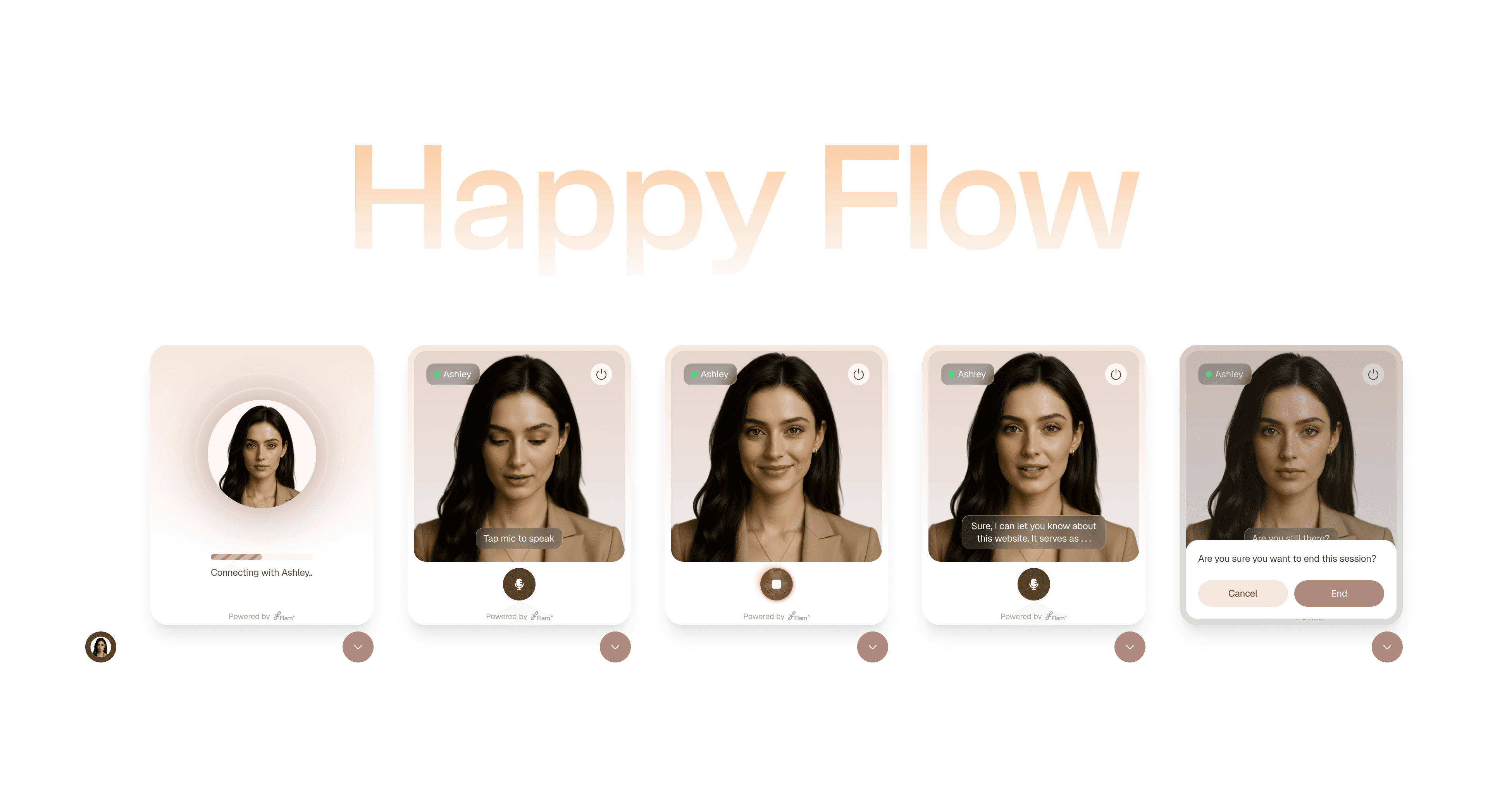
Unlike traditional interfaces, conversational AI operates through invisible system states. Users can't naturally tell when the assistant is listening, processing information, retrieving knowledge, or generating a response. My goal was to reduce this uncertainty by designing clear interaction states and feedback mechanisms that built confidence throughout the conversation.

Unlike traditional interfaces, conversational AI operates through invisible system states. Users can't naturally tell when the assistant is listening, processing information, retrieving knowledge, or generating a response. My goal was to reduce this uncertainty by designing clear interaction states and feedback mechanisms that built confidence throughout the conversation.

Designing Flexible Conversations

Designing Flexible Conversations

Different products require different levels of conversational engagement. Rather than designing a single interface, I created a flexible conversation framework that could adapt across Compact, Expanded and Inline modes while maintaining a consistent interaction model. The framework also supported rich responses such as images, tables, charts and structured content, allowing conversations to go beyond plain text.

Different products require different levels of conversational engagement. Rather than designing a single interface, I created a flexible conversation framework that could adapt across Compact, Expanded and Inline modes while maintaining a consistent interaction model. The framework also supported rich responses such as images, tables, charts and structured content, allowing conversations to go beyond plain text.

Designing for Scale

Designing for Scale

Since the assistant was built as a white-label product, every deployment needed to feel native to its host platform without requiring custom UI work. I designed a scalable theming system using dynamic color logic, enabling the experience to automatically adapt to different brand identities while preserving accessibility, hierarchy and visual consistency.

Since the assistant was built as a white-label product, every deployment needed to feel native to its host platform without requiring custom UI work. I designed a scalable theming system using dynamic color logic, enabling the experience to automatically adapt to different brand identities while preserving accessibility, hierarchy and visual consistency.

Outcome

Impact
  • Designed a reusable interaction framework supporting 15+ conversational states, ensuring users received clear feedback throughout the AI interaction lifecycle.

  • Created a white-label theming system that dynamically adapts to different brand identities while maintaining accessibility and visual consistency.

  • Designed support for 3 deployment modes (Compact, Expanded and Inline), enabling the same experience to fit different product contexts.

  • Built a flexible response framework capable of rendering text, images, tables, charts and other rich responses beyond traditional chat.

  • Shipped the experience across multiple deployment surfaces, including websites, embedded experiences and interactive kiosks.

  • Contributed to a production-ready AI product that was deployed for clients including Flam, SmartSense and the Delhi Tourism experience.

Key Learning

AI UX Is About Reducing Uncertainty:
Users care less about the model and more about understanding what the system is doing.

Voice Requires Stronger Feedback Than Visual Interfaces:
Without clear feedback, users quickly lose confidence in the interaction.

Systems Scale Better Than Screens:
Building reusable interaction frameworks proved more valuable than designing isolated experiences.
SHALAKA BALDE

shalakabalde1@gmail.com

Email copied!

+91 8251027909

Mobile copied!

SHALAKA BALDE

shalakabalde1@gmail.com

Email copied!

+91 8251027909

Mobile copied!

SHALAKA BALDE

shalakabalde1@gmail.com

Email copied!

+91 8251027909

Mobile copied!

Back

Create a free website with Framer, the website builder loved by startups, designers and agencies.